Start with where and how you will listen
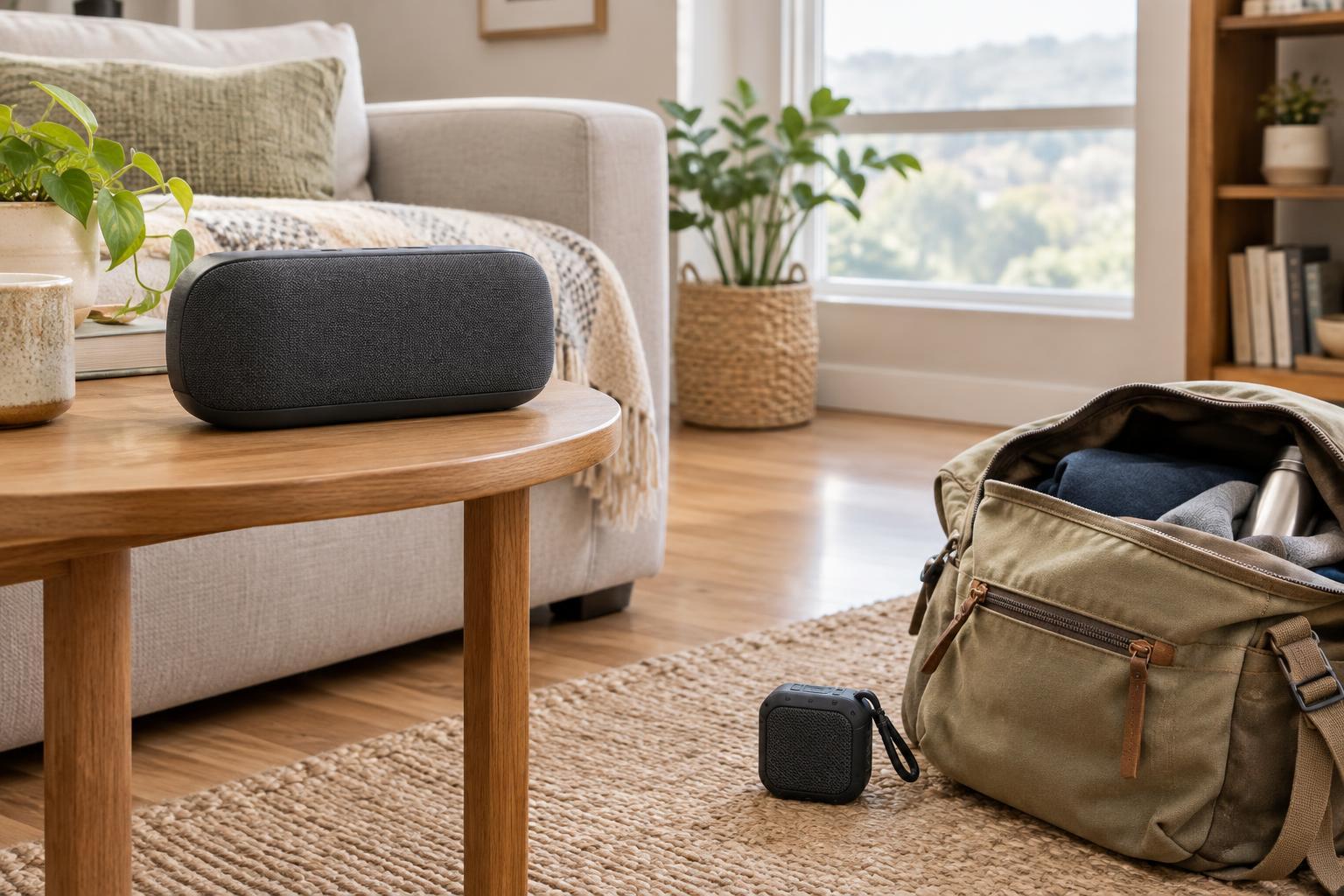
Before comparing specifications, picture a typical week with the speaker. Will it stay on a shelf, move between rooms or ride in a backpack? A home speaker can be larger and rely on a nearby outlet. A travel speaker needs to be comfortable to carry and easy to place on a small table, a picnic blanket or a hotel desk.
Think about listening distance, too. A speaker used beside you at a desk has a different job from one serving several people across a room. Small speakers can be convenient, but their size limits how much low-frequency sound they can produce. If you often listen in a large or noisy space, consider a bigger model rather than choosing solely by its advertised loudness. If you mostly listen quietly nearby, portability may matter more than maximum volume.
Judge sound by the experience, not one number
Speaker specifications rarely tell the whole story. Driver count, wattage and frequency-range figures can describe parts of a design, but they do not reliably tell you whether voices will sound clear or bass will overpower music. If you can listen before buying, try familiar tracks and spoken audio at the volumes you normally use. Notice whether dialogue remains intelligible, whether instruments sound distinct and whether the speaker becomes harsh when turned up.
Consider where the speaker will sit. A compact model placed near a wall may sound different from the same model in an open area. Some speakers are designed to project sound mainly forward; others aim for broader coverage. For a fixed spot at home, choose a shape and sound pattern that suit the seating area. For travel, predictable sound from several positions can be useful when you cannot control the room layout.
Bluetooth codec names can be tempting comparison points, but the speaker and the playback device must both support a codec for it to be used. Room placement and the speaker’s tuning may make a more noticeable difference in everyday use. If wireless audio delay matters because you watch videos or play games, check for a suitable wired input or a clearly stated low-latency option rather than assuming every Bluetooth connection will feel the same.
Match battery and charging to your routine
For a speaker that will live near an outlet, battery life may be a bonus rather than a deciding feature. On a trip, it becomes central. Treat advertised playback hours as a comparison starting point, not a guarantee: volume, bass-heavy audio, lighting and other settings can affect how long a charge lasts. Think in terms of your longest likely outing, then leave some margin so the speaker does not need constant attention.
Check how the speaker charges, whether it can play while charging and what cable or power adapter is included. A shared charging connector can make packing simpler, but do not assume that a USB-C port also accepts wired audio; charging and audio input are separate features. If you want to use the speaker for long days away from an outlet, charging convenience may be more valuable than a modest difference in claimed playback time.
Choose protection and controls you will actually use
Travel speakers face spills, dust, drops into bags and uncertain weather. An IP rating indicates tested protection against dust or water under specified conditions; it does not make a speaker indestructible. Compare the exact rating and the manufacturer’s care guidance if you expect to use it around a pool, at a beach or in the rain. For home use, a stable base and a finish that is easy to keep clean may matter more than rugged construction.
Try to imagine using the controls without looking at your phone. Clearly distinguishable volume and playback buttons are handy outdoors or while cooking. A carrying loop can be useful on a walk, while a handle may suit a larger speaker moved between rooms. If you expect to take calls, check whether the model includes a microphone and whether call controls suit your needs; not every portable speaker is intended to double as a speakerphone.
Check compatibility before paying for extras
Make a short list of must-have connections. Bluetooth is the common requirement, but an auxiliary input, multipoint pairing or a way to switch between devices may matter in a shared household. If you want two speakers playing together or a stereo pair, check the specific models and pairing modes supported. Speakers from different brands, or even different ranges from one brand, may not work together in the way you expect.
App-based equalizers, lighting and voice features can be appealing, but they add value only if you plan to use them. Decide on a comfortable budget after ranking your priorities: sound and easy placement for a mostly stationary speaker, or carry size, endurance and protection for a travel companion. A speaker that handles your ordinary listening well is a better choice than one packed with features that do not fit your routine.